If you avoid pork, eating in Japan can feel like walking through a minefield blindfolded. Pork isn’t just a topping here — it’s hidden in broths, cooking oil, fillings, and even snacks, and the menu almost never warns you. The good news? Once you understand where pork hides and how to ask about it, Tokyo opens up into one of the most rewarding food cities on earth.
I’m Mana, and I live in Tokyo. I eat out constantly with someone who avoids pork, so this guide isn’t copied from a database — it’s the stuff we’ve actually learned at the table: what’s safe, what’s sneaky, and exactly what to say. My goal is simple: help you eat well here without stress.
- Who this guide is for
- Why pork is so easy to miss in Japan
- The hidden-pork decoder
- What you CAN happily eat
- How to actually ask — and get a real answer
- Reading labels at the conbini and supermarket
- A real day of eating pork-free in Tokyo
- When you need stricter than this
- Frequently asked questions
- Take it with you
Who this guide is for
This is for travelers who avoid pork but aren’t strict about everything else. If you simply don’t eat pork — for religious, cultural, or personal reasons — this is written for you.
A few honest limits: this is not a halal-certification guide, and it doesn’t cover alcohol, gelatin, or cross-contamination. If you need certified halal food or strict separation, please use dedicated halal resources (more on that at the end). Everything below is about one thing done well: avoiding pork.
Why pork is so easy to miss in Japan
In a lot of countries, “does this have pork?” gets you a quick, confident answer. Japan is different, for two reasons worth understanding.
First, pork is often a base ingredient, not a visible one. A bowl of ramen can look pork-free and still be built on a pork-bone broth. A plate of fried rice can be cooked in lard. The pork is in the foundation, where you can’t see it.
Second — and this surprises people — Japanese food labeling doesn’t require pork to be declared. By law, only eight allergens must be labeled (egg, milk, wheat, shrimp, crab, peanut, buckwheat, and walnut). Pork isn’t one of them. On top of that, eating around a restriction is still relatively uncommon here, so restaurant staff often simply haven’t had to track it. It’s almost never unwillingness — ask kindly and most people will genuinely try to help. But the responsibility for checking sits with you.
The single most important takeaway: if a label doesn’t say “pork,” that does not mean it’s pork-free. It might just be unlabeled.
The hidden-pork decoder
Here’s where pork tends to hide, grouped by how it hides. Learn the pattern and you can predict the risk of almost any dish at a glance.
In broths and soups (invisible, high risk)
- Tonkotsu ramen — the word literally means “pork bone.” Always pork.
- Ramen in general — even soy, salt, or miso ramen often use a pork-blended broth, plus toppings like chāshū (braised pork) and pork back-fat. Treat ramen as high-risk unless confirmed.
- Tonjiru — a pork-and-vegetable miso soup. The name flags it.
- Good news: plain miso soup and most dashi are usually fish-and-kelp based, not pork — though instant soup bases can sneak in pork extract.
In fats and cooking oil (invisible)
- Lard turns up in fried rice, some pan-fried gyoza, and certain stir-fries and ramen. You can’t see it, so ask about the oil.
In fillings and mixed dishes
- Gyoza and shumai — the filling is usually ground pork.
- Nikuman / butaman — steamed pork buns.
- Mapo tofu, okonomiyaki, yakisoba, curry, fried rice, croquettes — frequently contain pork or pork fat. Always ask.
- Monjayaki — a beloved Tokyo griddle dish (you’ll find whole streets of it in Tsukishima), and well worth trying. The catch: the batter is mixed with a dashi that often contains pork extract. If you’re concerned, choose a seafood-focused monja — it’s just as much a local experience, without the pork.
In processed foods and sweets (the sneaky ones)
- Gelatin in gummies, jellies, mousse, and marshmallows is often pork-derived (though sometimes beef or fish). Since it’s not required on the label, absence isn’t proof.
- Pork extract hides in instant noodles, snacks, chips, and seasonings.
- Ham, bacon, and sausage show up in breakfast sets, bento, and convenience-store items.
The named-and-obvious (easy once you know the words)
- Tonkatsu, katsudon, shōgayaki (ginger pork), butadon, and yakiton are all pork. And watch the trap: yakitori is chicken, but yakiton is entirely pork.
What you CAN happily eat
It’s not all caution — Tokyo is full of food you can enjoy with confidence (a quick confirm never hurts):
- Sushi and sashimi — a safe, joyful default.
- Gyudon (beef bowls) and beef yakiniku — choose your cuts.
- Yakitori (chicken skewers) — just avoid mixed-meat skewers.
- Tempura — usually vegetable oil; confirm at the shop.
- Soba and udon — check the dashi and toppings.
- Tofu dishes, shojin (Buddhist vegetarian) cuisine, and seafood — broadly excellent.
How to actually ask — and get a real answer
This is the part most guides miss. A simple “no pork?” can still leave you with a pork broth or food fried in lard, because people picture visible meat. So ask about the soup and the oil by name.
A few phrases that get a straight answer:
- Kore ni butaniku wa haitte imasu ka? — Does this contain pork?
- Sūpu ni buta wa tsukatte imasu ka? — Is pork used in the broth?
- Rādo (buta no abura) wa tsukatte imasu ka? — Do you use lard (pork fat)?
- Butaniku nuki de tsukuremasu ka? — Can you make it without pork?
- Kore wa butaniku desu ka, gyūniku desu ka, toriniku desu ka? — Is this pork, beef, or chicken?
Pointing at the menu while you ask helps a lot. And if you can recognize a few characters, you’ll catch most pork before you even order: 豚 (pork/pig), ポーク (pork), ラード (lard), チャーシュー (braised pork), and 豚エキス (pork extract).
Reading labels at the conbini and supermarket
Convenience stores are a lifesaver for quick meals, but labels are in Japanese. Scan for 豚肉 / ポーク (pork), ラード / 豚脂 (lard), and 豚エキス (pork extract). Be cautious with ゼラチン (gelatin) and vague terms like エキス (extract). Remember the rule: because pork labeling is voluntary, a clean-looking label isn’t a guarantee — when it really matters, check the full ingredient list or ask staff.
A real day of eating pork-free in Tokyo
Here’s how an ordinary day actually goes for us.
Breakfast is the easy win: a convenience-store rice ball (we stick to salmon, tuna-mayo, or pickled plum), a coffee, maybe fruit. Five minutes, zero stress.
Lunch we’ll often do sushi or a beef bowl — both reliable. One day we wanted ramen, so we found a shop advertising a chicken-and-fish broth, and I asked about the back-fat and toppings before ordering. They confirmed, swapped the pork topping for extra egg, and it was one of the best bowls we’ve had.
Dinner is where we slow down. Izakaya can be tricky — lots of small pork dishes — so we lean on grilled chicken, fish, tofu, and vegetables, and we always check the oil for anything fried. The one time we got caught out was an “innocent” plate of fried rice that turned out to be cooked in lard. Now it’s the first thing we ask about. That single mistake is exactly why this guide exists.
When you need stricter than this
If you need certified halal, full separation from alcohol, or guaranteed no cross-contamination, this guide isn’t enough on its own — and I’d rather tell you honestly than pretend. For that, lean on dedicated resources like Halal Gourmet Japan, Halal Navi, and the official tourism guides, which list certified and Muslim-friendly establishments. Use this guide for everyday pork-avoidance, and those for stricter needs.
Frequently asked questions
Is ramen always pork? No, but assume it is until confirmed. Many broths are pork-based or pork-blended, and toppings are often pork. Some shops offer chicken- or fish-based bowls — just ask about the broth, the back-fat, and the toppings.
Can I eat sushi in Japan? Yes — sushi and sashimi are among the safest, most enjoyable choices for pork-avoiders.
How do I say “no pork” in Japanese? Butaniku nuki de (“without pork”) and Kore ni butaniku wa haitte imasu ka? (“does this contain pork?”) will carry you a long way. Asking about the broth and oil specifically gets the most accurate answer.
Is gelatin in Japanese sweets pork? Sometimes. It can be pork, beef, or fish, and it isn’t always labeled — so if it matters to you, check or ask rather than assume.
Take it with you
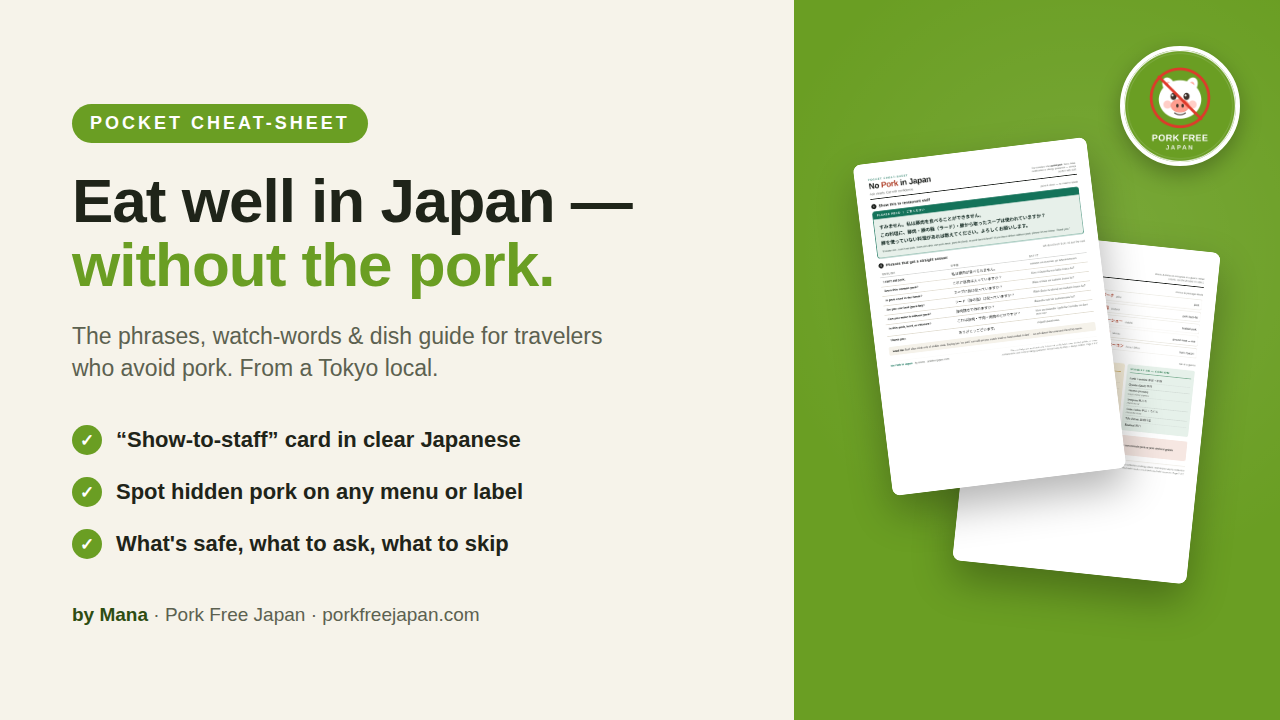
I turned the most useful parts of this guide — a show-to-staff card in Japanese, the phrases, the watch-words, and the full dish decoder — into a two-page printable Pocket Cheat-Sheet you can keep on your phone and pull up at the table. No Japanese needed.
👉 Get the Pork Free Japan Pocket Cheat-Sheet: https://porkfreejapan.gumroad.com/l/nopork
Eat well in Japan — without the pork.
— Mana, Pork Free Japan
This guide helps you avoid pork. It is not halal certification or allergy advice, and recipes vary by restaurant — always confirm with staff.

コメント